Become a DevOps engineer
with a personal mentor
An individual training program from a practicing DevOps engineer with experience since 1999. Real projects, an honest outcome - no empty promises or inflated expectations.
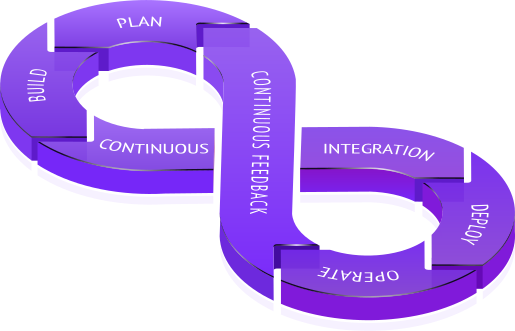
What is it?
This is individual mentorship for the most effective way to learn the DevOps engineer profession and achieve your ultimate goals: a higher salary, a higher grade, landing the job you want.
Graduates find jobs
Real reviews with names and dates.
What the program includes
Everything you need: from the first lesson to an offer in hand.
8 platform courses - lifetime access
A real project in production
Not a lab environment, not a synthetic example. You deploy a genuine microservice system that is running right now. This is what sets you apart from graduates of ordinary courses in an interview.
Microservice application in Kubernetes
// production · cloud · 20 services · terraform · ci/cd · helm
What you'll do
Cloud infrastructure via Terraform
Create a Kubernetes cluster and all dependent resources in the cloud (Yandex Cloud or AWS) through code - no manual clicking in the console.
Deploying 20 microservices via Helm
Describe each service as a Helm chart. Use Helmfile to manage dependencies and the deployment order of the entire stack.
CI/CD automation via GitLab
Set up a full-fledged pipeline: image build, tests, publishing to the registry, and automatic deployment to the cluster via GitLab CI and Git Flow.
Monitoring and observability
Stand up an observability stack: Prometheus + Grafana + Loki. Configure dashboards and alerts based on real service metrics.
Project stack
Network dependencies and service mesh
Get to grips with Ingress, Service, and NetworkPolicy. Connect the Linkerd service mesh for mTLS and observability between services.
Secrets management
Integrate HashiCorp Vault for secure storage and rotation of secrets without hardcoding them in manifests or environment variables.
Databases and message brokers
Deploy PostgreSQL, Redis, NATS, and Consul as part of the cluster infrastructure with persistent storage.
Code review and final defense
Alexander will personally review all of your code: manifests, pipelines, Terraform modules. You'll get detailed feedback - just like a real code review on a team.
Technologies for your resume
An up-to-date commercial stack that is in demand on the market right now.
How it differs from other courses
People come to me even after courses on well-known platforms - because a quality result in the mass market is the exception rather than the rule.
| Criterion | DevopsTrain | Other platforms |
|---|---|---|
| Individual training plan | ✓ | ✗ |
| Real commercial project Genuine production, 20 microservices | ✓ | ✗ |
| Personal mentor for the whole term | ✓ | ✗ |
| Priority email support | ✓ | ✗ |
| Resume help | ✓ | ✗ |
| Mock interview | ✓ | ✗ |
| Interview question database | ✓ | ✗ |
| AI assistant Trained on the course materials | ✓ | partially |
| Lifetime access to materials | ✓ | rarely |
| Project code review | ✓ | ✗ |
| Access to the DevOps cases database Only in this program | ✓ | ✗ |
| Students at the same time Quality over volume | max. 5 | hundreds |
| Course updates | continuously | rarely |
| Price / outcome | ↑ higher | ↓ lower |
It's also worth noting that people come to this program even after «courses» on well-known platforms, because a quality result in the mass market is the exception rather than the rule. Of course, I can't and don't plan to compete with those institutions, because making empty promises about a 300K salary in a nanosecond and employment guarantees is definitely not my style. I only promise to give my maximum - the rest depends on the student. By the way, my students already have their first positive results from the mentorship program, which I'll tell you about soon.
Since I'm not willing to sacrifice the quality of training and support, I unfortunately can't take on more than 5 people at the same time. But because the workload is uneven and because people finish their training and spots open up, feel free to reach out and we'll discuss your case.
UPD: for June 2026 there is 1 spot
What graduates say
Updated 11.05.2026 · 9 reviews with real names and dates.
I moved out of a department where nobody really understood what I did and where I was basically doing sysadmin work, because it was a purely back-office department for handing out equipment to employees and so on. Now I've moved to a development department where there are more product-related tasks, and I'm something like the lead - the manager responsible for DevOps practices, meaning he runs all the DevOps people in development and makes the key decisions about it. I moved with a salary increase. The Kubernetes course helped a lot at the start, because it's reeeally hard to grasp right away - you really need to dig into it meticulously, and the way you present it helped a lot. And overall the whole course is very useful, with Linux, networking, ci/cd, docker too. Before taking your courses and the mentorship in general, I bought Rebrain - it was too tedious there because you can't go at your own pace and in whatever order you want. I had to study Git in painstaking detail with all its tricks, 90% of which I never use, and if I do need something specific, I can always look it up through AI. In short, you have great hands-on practice, and it fits well in your head alongside the theory. One more thing I'd point out: what makes good courses work is that the information is structured, so you don't have to think about where to go, what's actually needed, and what's junk that will never be useful. I specifically had that problem, and you helped a lot in solving it, and after that it just rolled along on its own. And AI, when you use it already understanding what you actually need, makes life a lot easier)
Overall, I've fully completed the DevOps course with mentorship from Alexander. My training took not 6 months, as originally planned, but about 8 - but it was definitely worth it. First, a huge advantage of the course is the ability to go at your own pace. For me this was critically important (I have something to compare it to: I've taken other courses where you're forced to keep up with the group's rhythm). I have a job in IT, and sometimes the workload increased a lot, plus flights - there were times when I had no time at all. So the flexibility of the training here is a real lifesaver. These 8 months flew by very fast. I'd also like to note that the course is very well structured: first you get the theory, then immediately the practice. This really helps cement the knowledge rather than just «listening through» the material. The automatic validation of tasks is implemented nicely - it speeds up the learning and gives quick feedback. At the same time, Alexander reviews the final (exam) project personally: he does a full code review with detailed and to-the-point comments. And what especially pleased me - you don't have to wait weeks for a response. You submit in the evening - and get the review the next morning. Another important point - access to the platform remains after the course ends. Essentially, it's a whole knowledge base you can come back to in your work. What's more, the materials are constantly updated and expanded. As a result, I leveled up my skills a lot: I've already deployed my own self-hosting «data center» at home and on rented servers. Now I devote almost all my free time to it and am actively preparing for interviews. To sum up, the course gives you: • a clear and structured training program • a balance of theory and practice • up-to-date knowledge that is in demand on the market • quality and fast feedback • access to the community • and permanent access to the platform with a large amount of useful information I'd also like to express my gratitude to Alexander for his involvement, prompt feedback, and attentive attitude toward his students. You can feel that it genuinely matters to him that students don't just complete the course, but really understand the material and grow as professionals.
I came to you in August of this year with the goal of leveling up both in technologies I already knew and learning new ones (let's count Kubernetes as new, since at work I only touched it once every 2-3 months), getting familiar with new workflows, learning to pass interviews, and choosing how to behave depending on the situation. On salary, I hoped to grow to 250-270k, to not bomb at least some technical interview, and to get an outside assessment. The job search took about 1 month, and the training took 3 months of daily and fairly intense work. The results: • An offer of 400k, a middle position (obviously the requirements there are like for a "Senior Tomato", but the salary matches too =)) • I finally learned to explain theory clearly and stopped ending up in situations like "I know how it works, but I can't explain it" • After working on Kubernetes for ~1.5 months during the training, at the interview I got a "senior+" rating in that section. I'll add that there were other successful technical interviews for positions focused on Kubernetes too • I got a work cheat sheet in the form of your articles and all the manifests I developed during the course (even at my current job it was easier to look up what I came up with during the training than to reinvent the wheel. I'm sure all of this will keep being useful) What I'd like to point out and give special thanks for: — You instilled confidence in me and helped me overcome "impostor syndrome". "You can clearly find better options", "ask for 300-350k" - things I didn't expect to hear, but heard, and they had a decisive impact on how I see myself in my profession. I was already thinking about becoming a taxi driver or going to work at a factory) — Substantive answers to everything, even the silliest questions, sometimes not closely related to the training — The courses are built so that you have to return to already-covered topics many times, which further cements the material and tools. This way you get the hang of it, memorize the syntax and the quirks of working with the tools — Providing the infrastructure and a domain makes life much easier — The getting-started guides for many tools are better than the developers' docs, which gives you a chance to try new tools and get a basic understanding of how they work — Building a community and keeping in touch are an extra plus. You can tell you care about your students) — The troubleshooting course (a great exam/game/cheat sheet, helps you get the hang of it nicely) — The course and the blog are not stuffy to read at all) The outcome exceeded my expectations. It was a tough road (obviously, to earn money you need to be able to do something =)) and I'm deeply grateful for all the help you provided. I think I'll feel the need for your advice more than once or twice more (as they say in sports, every coach needs a coach - it's always clearer from the outside, and officially I haven't become a "Senior Tomato" yet =))
I took mentorship with Alexander and landed a job in fintech with a salary of 350K. Alexander has his own platform with tasks; literally from the very first task you dive into hands-on practice, and it's very interesting. The serious approach to the work helps you build a good foundation and feel confident on the job afterward. Alexander is always available for any questions, and there's also a handy AI bot trained for the program. Under Alexander's guidance, I completed a project assignment in which I practiced the skills of building cloud IaC infrastructure with Terraform. It's great that the courses remain accessible; I now use them as a knowledge base, and it helps a lot in my current job.
An excellent course focused on a hands-on approach, with no fluff. The individual consultations and answers to questions are undoubtedly a huge plus that sets this platform apart from the rest.
• The training program provides a carefully curated set of relevant knowledge from a practicing DevOps engineer, with no fluff and no hours-long lectures. The goal of each workshop is to quickly bring the student into the subject through a concrete example. Each course is a set of logically connected hands-on tasks with a small theoretical part. The result of completing each course is gaining an understanding of how the technology being studied works: what problems it solves, where, for what, and in which cases it's used. • A convenient platform whose access is retained after completing the courses. You can later use it as a cheat sheet in your work. As lab environments, you either use the virtual infrastructure provided by the platform (for the linux, k8s, and ci/cd courses) or your own computer / VM or resources rented in a public cloud (for the docker, terraform, and project assignment). There were no problems over 7 months of training - any minor things were resolved as promptly as possible. • Support and loyalty. For any question that comes up during a course, you can reach out to the author and get a prompt answer. Here I see a big advantage compared to courses on popular platforms - there are no constantly changing mentors, no delays in answering questions, no broken VMs, no access problems, and so on. • The presence of a real project assignment. One of the key parts of the training - while doing the project assignment, you get the chance to recall the material you studied and, under a mentor's supervision, apply the acquired skills and knowledge on a real project, simulating the work of a Junior DevOps engineer / intern. You can go the whole way from A to Z - from preparing the infrastructure to automatically deploying the application to production. In the end you get a finished, working project that, if needed, you can partially keep (your own code) and demonstrate when job hunting. Conclusion: an excellent workshop for those who already have basic knowledge of the technologies being studied and an understanding of concepts related to microservice architecture and CI/CD methodologies, or for those who are ready to broaden their horizons on their own and look for the additional information needed to master the material (luckily, there are plenty of sources - the curator, Google, YouTube, etc.). In both cases, the resources spent on completing the training will definitely not be wasted.
Decent courses, lots of practice. Personally, the greatest value for me was communicating with Alexander. Going through the courses and periodically having calls, working through questions both from the courses and from past interviews, in the end I was able to feel more confident, pass a couple of tough technical calls, and get an offer.
I'm very grateful to the course creators for the mentorship program, in which I completed the entire package of training courses. The project assignment allowed me to immerse myself in the DevOps field and gain the skills to deploy cloud infrastructure. Under Alexander's guidance, I completed a project assignment in which I practiced the skills of building cloud IaC infrastructure with Terraform. I figured out how to set up continuous CI/CD development processes on GitLab. I gained invaluable experience that will be useful in the future.
I recently completed the "Mentorship Program" course and was satisfied. The course was well structured, and the materials were clear and accessible. The hands-on tasks helped me better understand the theory and apply it in practice. I especially want to highlight the mentor's work. He always responded quickly and gave useful advice. After finishing the course, I was able to get a job at an IT company. The knowledge and skills I gained played a key role in this. If you do the "Project" at the end, consider that you've gained experience on a commercial project. In an interview, talk about the project, what you used, and what you worked with. Your experience will be much greater than from other courses. I recommend this course to anyone who wants to deepen their knowledge of DevOps and find a job in this field.
What platform is the training on?
All of the listed courses are built on my own platform, purpose-built for these goals. From the start, I decided to build the platform from scratch in order to implement all the ideas behind effective learning.
The platform has automatic task validation, which is very important when the training is hands-on. For the Docker and Terraform courses, a dedicated open-source helper tool Kurator was built to make task validation possible.
Roughly every 2-3 months, the platform's functionality is expanded based on user requests. According to internal statistics, currently dozens of people interact with the platform every day to study the material and quickly find a solution to a problem that comes up in their work. The form for contacting the author directly helps a lot with this.
The price is individual
It depends on your level and experience. Send your resume or briefly describe yourself.
- ✓ Installments: 33% + 33% + 34% monthly (+10%)
- ✓ Interest-free installments 50% + 50%
- ✓ Long-term bank installments
- ✓ Discount for those who have already bought courses
- ✓ Payment by your employer is possible

A practitioner, not a theorist
In IT since 1999 - I started with development and server setup even before the term «DevOps» appeared. I've worked at large companies and startups, both Russian and foreign, in DevOps engineer and DevOps Team Lead roles.
I built my own DevopsTrain platform from scratch - with automatic task validation and a dedicated open-source tool Kurator for Docker and Terraform. Dozens of people interact with the platform every day.
- Expert knowledge from real commercial practice
- Attentive treatment of everyone - no more than 5 students at the same time
- I recommend students to HR contacts I know; there are internship arrangements with two companies
- Openness to feedback - the courses are updated significantly more often than the platform
FAQ
Answers to the questions most often asked before getting started.
Submit a request
The price is set individually - describe your experience and I'll get back to you shortly